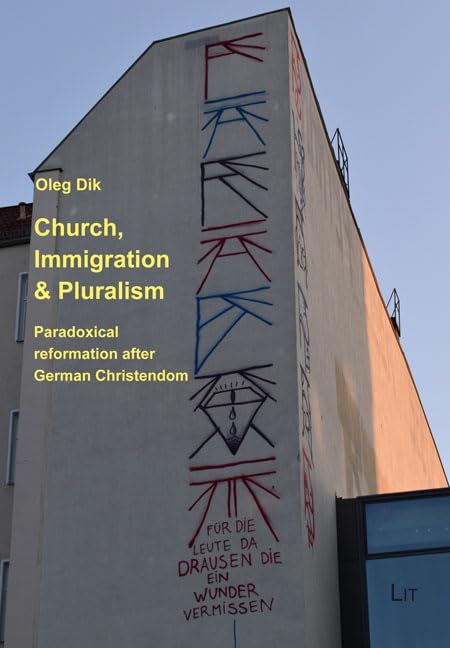
Church, Immigration & Pluralism : Paradoxical reformation after German Christendom.
Material type: TextLanguage: German Series: Theologie ; Band 122Publisher: Berlin, Münster LIT 2022Description: 361 SeitenContent type:
 - Text
- ohne Hilfsmittel zu benutzen
- 978-3-643-91424-8
- F
| Cover image | Item type | Current library | Home library | Collection | Shelving location | Call number | Materials specified | Vol info | URL | Copy number | Status | Notes | Date due | Barcode | Item holds | Item hold queue priority | Course reserves | |
|---|---|---|---|---|---|---|---|---|---|---|---|---|---|---|---|---|---|---|
 Buch
Buch
|
AWM Korntal Raum 2/3 | F 56.3 Dik (Browse shelf(Opens below)) | Available | 01225853 |
Klappentext This book wrestles with the question of how the church can thrive in such a diverse urban environment as Berlin and contribute to the flourishing of a pluralistic society. The study includes embedded experience on the streets and crosses the disciplinary divides of Sociology & Theology. The main claim of the book is that the church is only able to thrive when it is willing to descend into the messy urban reality and encounter the stranger. However, the church can only do so by glimpsing God's glory in worship. Living pluralism emerges from the grassroots. The church can only become a gift to society paradoxically: By not setting itself at the center, but rather by gathering around the triune God and abandoning its desire for power and relevance, the church will unintentionally provide a fertile soil within which resilient pluralism will grow. Oleg Dik is professor for urban Theology & Sociology at the Evangelische Hochschule TABOR, Marburg / TSB Theologisches Studienzentrum Berlin and lectures occasionally at Humboldt University Berlin in Sociology of Religion.
There are no comments on this title.